
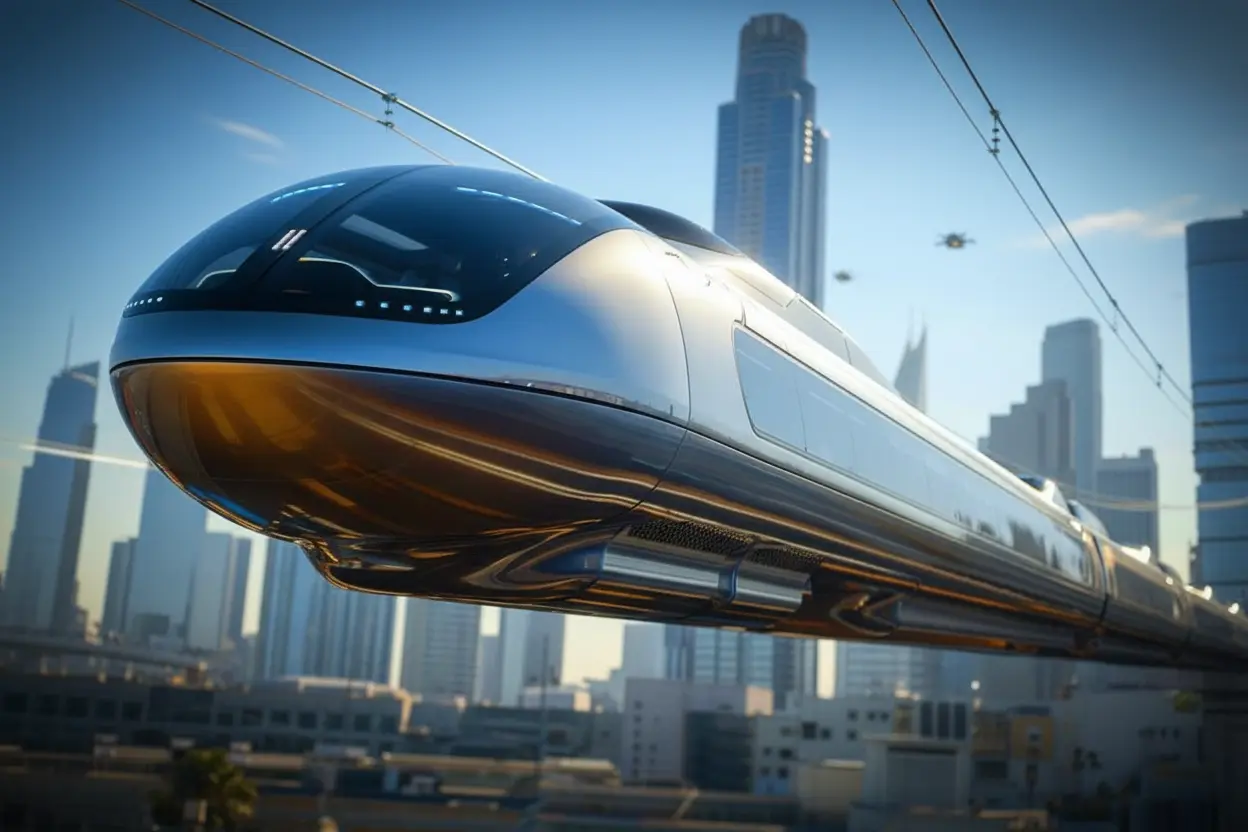
The future of travel might just be on the horizon—and it could arrive at speeds that make airplanes jealous. China has taken a bold step with its groundbreaking Hyperloop, a supersonic train system that could transform how millions move between cities. Is this the dawn of a new era in transportation, or just the latest high-speed race no one saw coming?
A Leap Forward: The Hyperloop in Action
Let’s set the scene in the east, where innovation and ambition often shake hands. China has made significant progress in developing its supersonic Hyperloop, a revolutionary blueprint that combines magnetic levitation with travel through low-pressure tubes. The goal? Achieve speeds comparable—and in some cases superior—to those of commercial airplanes. Yes, you read that correctly: trains might soon be overtaking planes, and not just in the punctuality stakes.
In Datong, Shanxi province, an experimental track stretching 2 kilometers has become the testing ground for China’s first full-scale Hyperloop maglev prototype. Floating thanks to magnetic levitation, the train glides above its track, wiping out friction entirely. And by traveling inside a reduced-pressure environment, air resistance drops dramatically, making those sky-high (quite literally) velocities attainable. Just imagine: no bumpy ride, no rattling windows—just pure smooth acceleration.
Promising Results—And a Few Secrets
Now, you might wonder just how fast this thing goes. Sorry to disappoint the speed enthusiasts, but official details about record-breaking velocities remain under wraps. Chinese engineers have, however, reported encouraging results—so promising, in fact, that they consider this experimental phase a milestone for the future of train travel. No small claim, considering the country’s success with high-speed rail.
This ambitious project reflects the joint efforts of the Shanxi government and the China Aerospace Science and Industry Corporation (CASIC). For both players, Hyperloop isn’t just another train—it’s a strategic infrastructure project meant to rewrite the rules of travel. Their targets are nothing short of game-changing. Imagine the journey between Beijing and Shanghai, once a marathon of 4 to 5 hours on high-speed trains, being cut down to just 90 minutes.
Dreams, Obstacles, and Questions
If all these promises come to life, China’s Hyperloop could revolutionize travel between megacities, bringing major benefits for the economy and daily commuters. But let’s put on the brakes for a moment. The Hyperloop’s bright future is shadowed by a multitude of big questions, some as hefty as the investments needed to build it.
Rolling out such a massive infrastructure will require colossal funding, not to mention thorough analysis of its environmental and social ramifications. It isn’t only about laying down a new track; it’s about rethinking the whole transport logistics game. To work, this futuristic network must:
- Integrate seamlessly with existing infrastructure
- Minimize scenic and environmental disruption
- Maintain a system that demands ultra-precision engineering
There’s another key question: will these jaw-dropping trains find their riders? And at what price? After all, any investment (even one that comes with the promise of breaking sound barriers on rails) needs to make sense in the long run.
China’s Bet: A Model to Imitate—or Fear?
With its supersonic Hyperloop, China is positioning itself to open a new chapter in the history of transportation. If the country can overcome technical and economic hurdles, it could redefine not just the concept of travel times, but the very idea of distance—a feat that may provide the rest of the world with either a model worth copying or one that stokes a little envy (and maybe a dash of apprehension).
Ready or not, the way we connect our cities may never look the same again. For now, one thing is clear: the race for the fastest ride on earth is anything but over. If you’re planning your next cross-country commute, keep an eye on the east. The world may be about to shrink, and not just on your map.

John is a curious mind who loves to write about diverse topics. Passionate about sharing his thoughts and perspectives, he enjoys sparking conversations and encouraging discovery. For him, every subject is an invitation to discuss and learn.