
Confused in Germany? You’re not alone. A brand-new road sign meant to make streets safer is leaving drivers scratching their heads—and, occasionally, fumbling for the handbrake.
Germany’s Bold Move in Road Safety
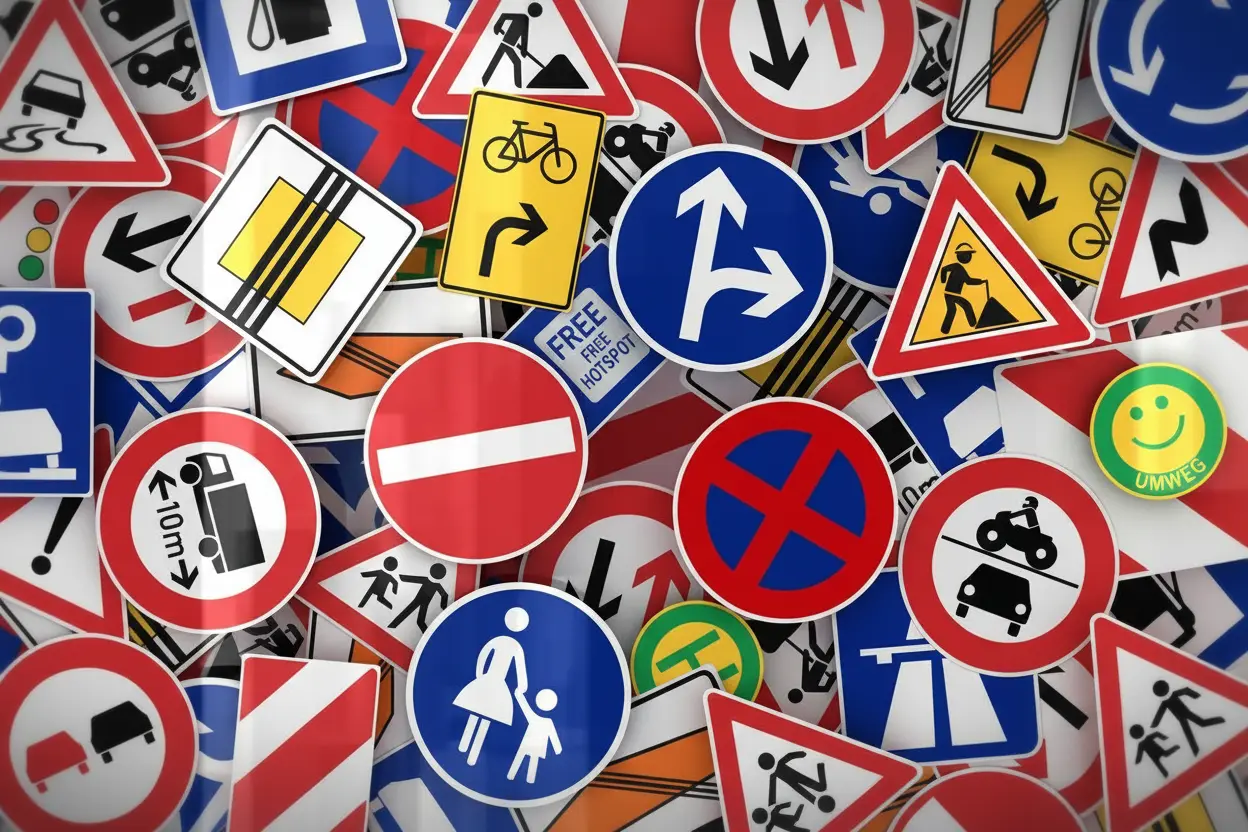
Imagine cruising down a German street when you spot a new, striking sign: a round shape with a red border, displaying a bright red car next to a black bicycle and a scooter. Let’s clear the fog right away—the intention is straightforward. This sign means cars are prohibited from overtaking two-wheelers, whether that’s cyclists or those on scooters. It’s Germany’s answer to the boom in “soft mobility,” the rise of bikes and e-steps redefining how we share the road. The main goal? Prevent those nail-biting overtaking maneuvers that make both drivers and cyclists briefly reconsider their life choices.
So Simple, So… Misunderstood?
Simplicity, however, is a slippery concept. Drivers have managed to find a spectrum of interpretations, some more creative than others:
- Some think the sign bars cars from the road entirely. (Wouldn’t that be a sight!)
- Others shrug it off as just a friendly heads-up: “Hey, watch for cyclists.”
The confusion is far from trivial. It’s so widespread that German authorities have rolled out information campaigns and even revamped lessons in driving schools to get the message across. Clearly, understanding a road sign should not require a PhD, but that’s where Germany finds itself.
Why So Confusing? The Great Road Sign Dilemma
This signals a broader headache: How do you design road signs that drivers grasp instantly, especially when traffic itself is getting more complex? Drivers are already flooded with visual information—should we pile on another symbol they’ve never seen before? Suddenly, what should aid safety might momentarily threaten it with a burst of confusion at 50 kilometers per hour.
Hans Mueller, a professor at the University of Munich, weighs in with academic gravitas. He insists that signs need to balance simplicity and precision. With ever-growing numbers of cyclists, e-scooter users, and pedestrians joining the fray, hitting that trifecta is no easy feat. Strikingly, it’s not just a German challenge: The wild variety in traffic signals across European countries only adds to the chaos for the globe-trotting driver.
Currently, Germany is going all-in on overtaking bans for two-wheelers, while France and Spain opt for different cyclist-protection tactics. This patchwork approach leaves the European Union scratching its own collective head, pondering how to standardize road signals. After all, a red car in Berlin should mean the same thing as a red car in Barcelona, at least in theory!
Changing Habits, One Frustrated Driver at a Time
But deciphering the sign is only half the journey. Drivers must also change how they behave behind the wheel. That means—brace yourself—sitting patiently behind a cyclist on a narrow road, instead of gunning for a risky overtake. Sure, some drivers may find this maddening, but the reward is well worth the wait: Road safety shoots up when cars stop playing dangerous leapfrog with two-wheelers.
The shift has its champions. Cycling associations are giving the measure a standing ovation. “This sign is a big step forward for our safety,” declares Andreas Klein, chairman of the Bavarian Cyclists’ Association. And there’s evidence to back up the applause: In regions already featuring the new sign, the number of dangerous overtaking maneuvers visibly dropped within just six months.
In a landscape where every second on the road is already spoken for by another arrow, triangle, or exclamation point, a new sign can’t afford to be cryptic. For now, German drivers must learn and adapt. And if in doubt, just remember: When you see a red car next to two-wheelers, your cue is to hit the brakes, not the pedal. The cyclists of Germany thank you in advance!

John is a curious mind who loves to write about diverse topics. Passionate about sharing his thoughts and perspectives, he enjoys sparking conversations and encouraging discovery. For him, every subject is an invitation to discuss and learn.